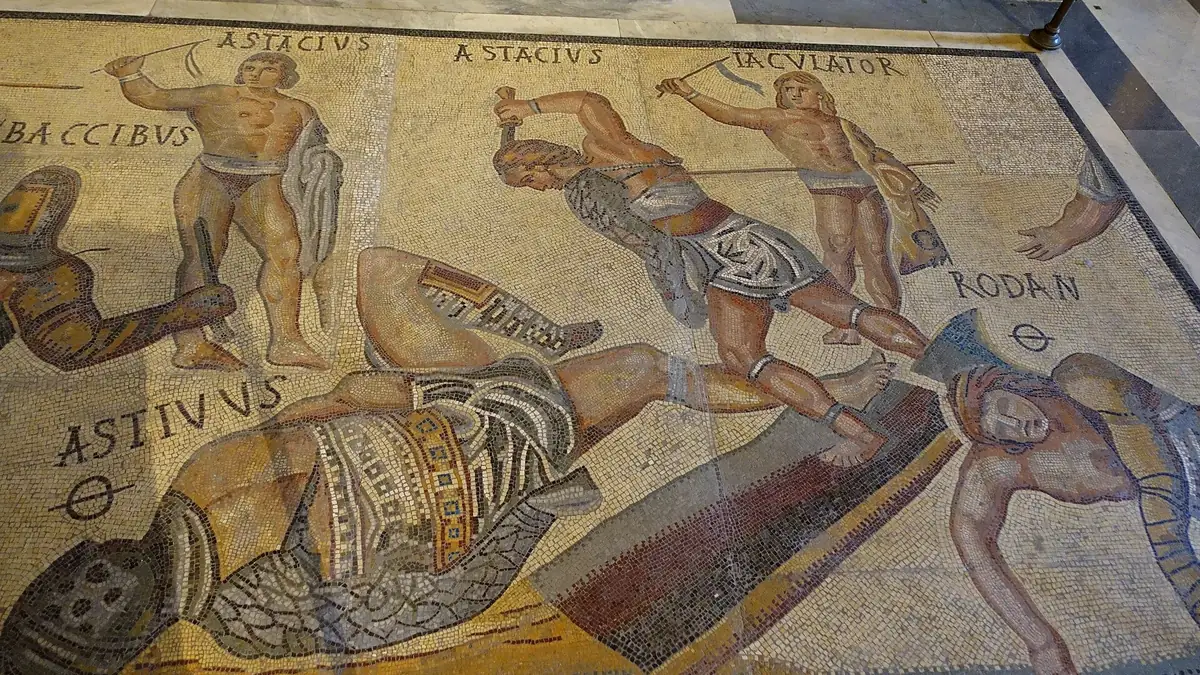
Gladiators & the games were the Colosseum’s whole reason to exist: animal hunts and gladiatorial games, staged for crowds until the end of antiquity. This page sorts the big picture, then sends you to the 13 guides that answer one question each.
At a glance: Two kinds of show: hunts and gladiator fights · Games abolished in 438 · Daytime underground ticket €24, 90 min
“spectacles of great popular appeal, such as animal hunts and gladiatorial games” Parco archeologico del Colosseo
What were the gladiator games?
They were two separate shows that people lump together. The Park names them as animal hunts and gladiatorial games, which its night tour calls venationes and munera.
Honestly, most myths start by blending the two. Hunts were about beasts, fights were about trained men, and the questions people ask (who, how many, how lethal) have different answers for each.
Can you still see where the games happened?
Yes, more than you’d expect. The Park describes the Colosseum as the largest amphitheatre in the world, with stage machinery that was surprisingly complex, and part of that machinery lives beneath the arena.
The Colosseum Museum has a bay on the profession of the gladiator and the subjects of the venationes, with graffiti, mosaics and reliefs. I’d book the underground and arena visit if you only do one thing: €24, 90 minutes. Walking the floor and the corridors below it is where the shows stop being abstract. Our full guide to the colosseum underground and arena floor covers it.
When did the games end?
In 438, Valentinian III abolished the gladiatorial games, and the amphitheatre began a slow decline. Later centuries turned it into a quarry, a shelter for animals, even a place for craft workshops and houses.
Say you arrive at the gate with a free afternoon and a head full of film scenes. You’d walk in expecting the Hollywood version, and the building itself, stripped and patched long after the games ended, tells a quieter story. Start with the museum bay, then go down.
Which gladiator question should you read first?
Pick the one that nags you. Every page below answers one question and links back here.
If you want one starting point, I’d take the day-at-the-games page, because it ties the rest together.
Map, starting points: Colosseo metro (Line B) · Piazza del Colosseo
Frequently asked questions
Is this section about the film or the real history?
The real history. Films are fun, but each page here sticks to what opened sources say and flags where evidence runs thin.
Do I need a ticket to understand the games?
No, the guides here work from your sofa. A visit helps though, since the museum and the underground make the spectacle physical.
Did gladiators and animal hunts happen together?
They were different shows, called venationes for hunts and munera for fights. Reading the animals page and the gladiator pages side by side shows how different they were.
Where do I go after this page?
Take the day-at-the-games guide for the overview, then branch by curiosity. If you’re planning a trip, jump to the underground page.
More on the games: day at the games · fight to the death? · underground and arena floor · home