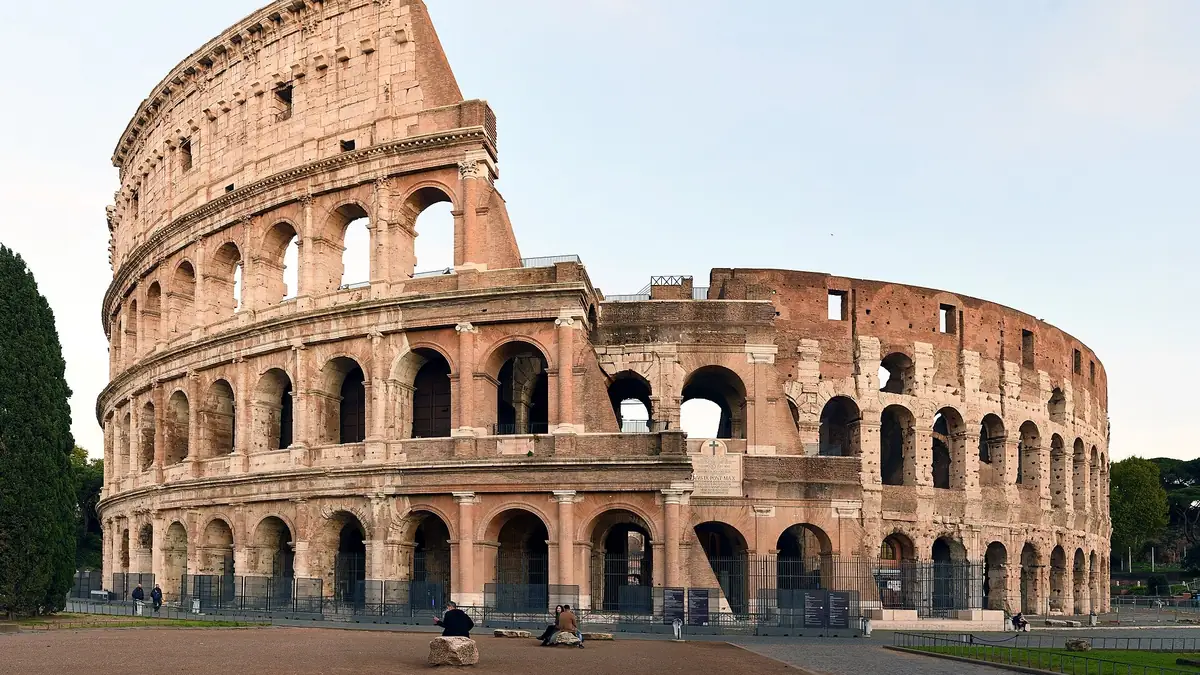
Colosseum architecture means a freestanding Roman amphitheatre: stacked arched tiers, a central arena, and stage machinery underneath. The Park calls it the largest amphitheatre in the world, and this section walks it from the arena floor up to the attic.
Key figures: built in the 1st century CE · games abolished 438 · arena-only visit 20 min · attic groups of 25 every 30 min
“The building was, and still remains today, a spectacle in itself.” Parco archeologico del Colosseo
What makes the Colosseum’s architecture special?
It was built as a machine for crowds, not just a big ring of stone. The Park describes complex stage machinery as well as services for spectators, so the arena, the tiers and the underground work as one design.
I’d stop thinking “ruin” and start thinking “stadium”. That shift makes the rest of this section click: the arches are circulation, the arena is a stage, and the basement is backstage.
Which parts of the Colosseum can I actually visit?
It depends on the ticket. The standard Park ticket opens the first and second order without the arena, while other Full Experience tickets add the arena, the underground or the attic.
The underground is subject to availability on its ticket, and the attic means steep steps and timed groups of 25. Honestly, if the underground matters to you, book that one first and fit the rest around it. For the basement itself, our colosseum underground and arena floor page goes deeper.
Why does so little of the original Colosseum survive?
Because people kept using it. After Valentinian III abolished the gladiatorial games in 438, the building declined, and later it became a quarry, with part of the stone used for St. Peter’s Basilica.
Houses, workshops and animal shelters moved in too. What you see today is the survivor of centuries of reuse, then systematic excavation and restoration. Say you stand in the arena and wonder why so much is missing… the quarry years are the short answer.
How long does a visit to the architecture take?
Plan on 75 to 90 minutes inside. The Park says the permanence period is 90 minutes for attic and underground tickets, and an arena-only ticket gives 20 minutes on the arena.
That’s tight for a building this layered. I’d read the relevant page below the night before, so the 90 minutes go on looking, not on working out what you’re looking at.
Where should I start in this section?
Start with the page matching your question. Every page below covers one part of the building, and the table lists them all in the order I’d read them.
| Question this page answers | Page |
|---|---|
| What is inside the Colosseum? | Inside the Colosseum: Every Level Explained |
| How many people did it hold? | How Many People Did the Colosseum Hold? |
| How big is it? | How Big Is the Colosseum? Height and Dimensions |
| What materials were used? | What Is the Colosseum Made Of? Materials Explained |
| How was it built? | How Was the Colosseum Built? Construction Explained |
| What did it look like originally? | What Did the Colosseum Look Like Originally? |
| What was the hypogeum for? | Colosseum Hypogeum: How the Underground Worked |
| Did it have a roof? | Did the Colosseum Have a Roof? The Velarium |
| Where did the emperor sit? | Where Did the Emperor Sit? Colosseum Seating |
| How much is original? | How Much of the Colosseum Is Original? |
| What does a map show? | Colosseum Map: Levels, Entrances and Routes |
| What was the arena? | The Colosseum Arena: Sand, Floor and Spectacles |
If you’re short on time, the map page and the levels page first. The rest is rabbit hole, the good kind.
Frequently asked questions
Why is it called the Colosseum?
The Park says the building became known as the Colosseum because of a colossal statue that stood nearby. Its formal name is the Flavian Amphitheatre.
Is the Colosseum the largest amphitheatre ever built?
The Park describes it as the largest amphitheatre in the world. The exact numbers sit on the dimensions page.
Can everyone climb to the attic?
No: the attic is reached only by climbing steep steps. The panoramic lift is reserved for visitors with documented mobility difficulties.
Is the Colosseum still used for events today?
Yes. The Park says it periodically hosts temporary exhibitions as well as modern spectacles.
More architecture: what is inside · the underground · Colosseum map · back to the guide home