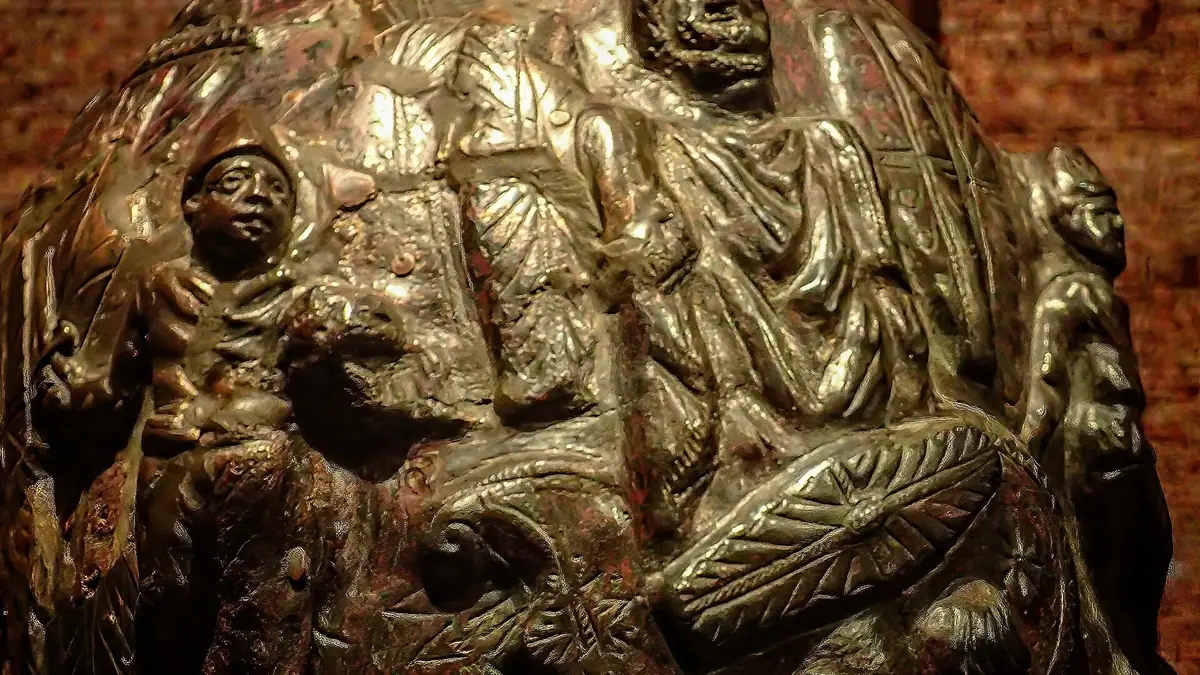
The roman gladiators helmet was never one design. A secutor’s was smooth and round, a thraex’s broad-rimmed with a griffin on the crest, and a net fighter wore none at all. Below is who carried what, why, and where in Rome you can look at the real thing.
What helmets did Roman gladiators wear?
Each type had its own. The secutor’s was round and smooth with two small eye-holes, the thraex’s broad-rimmed with a griffin on the crest, and the retiarius fought bareheaded.
The smoothness wasn’t style. The secutor’s helmet was round and smooth so a retiarius’s net could not grip it, and the eye-holes were tiny to keep out trident prongs. The murmillo got a fish on the crest. Helmets survive too: one was found in the gladiator barracks in Pompeii, another at Herculaneum.
| Type | Head | Shield | Main weapon | Usual opponent |
|---|---|---|---|---|
| Murmillo | Fish-crest helmet | Tall oblong | Gladius | Thraex |
| Secutor | Smooth, round, full-face | Tall rectangular | Gladius | Retiarius |
| Thraex | Broad-rimmed, griffin crest | Small round or square | Sica | Murmillo or hoplomachus |
| Retiarius | No helmet (sometimes a galerus) | None listed | Trident and net | Secutor |
| Hoplomachus | Brimmed, plumed | Very small, round | Gladius and spear | Murmillo or thraex |
Equipment and pairings from Wikipedia’s list of Roman gladiator types. No official site publishes this, so I leaned on the best open reference.
What shields did gladiators carry?
Two sizes. A scutum was the large shield, a parmula the small one, and the trade was legs: small-shield fighters wore two greaves, large-shield fighters usually one short greave.
Murmillones carried a tall, oblong shield in the legionary style, hoplomachi a tiny round one. I like the logic. Cover your body or cover your legs, never both.
What swords and tridents did gladiators use?
The murmillo’s gladius ran 64 to 81 cm, the thraex’s curved sica about 34 cm. The retiarius carried a trident and net, kit styled on a fisherman’s.
The hoplomachus threw his spear first, then closed in. The dimachaerus used a sword in each hand. And the scissor? One scholar suggests a steel tube over the forearm with a half-moon blade, and it’s only a suggestion.
Key figures: gladius 64–81 cm · sica about 34 cm · 2 greaves with a small shield · 1 breastplate-wearing type only
What armour did gladiators wear on their bodies?
Surprisingly little. A loincloth, a belt, an arm guard (manica) and greaves, with only the provocator wearing a breastplate.
So much for the film image of full plate. The retiarius’s manica ran up to the shoulder and across the left chest, and a galerus sometimes shielded his neck. The cestus fighter had no armour whatsoever.
Did gladiators wear different gear for the parade and the fight?
Yes. Elite gladiators wore decorative armour for the pre-game parade (pompa), while the fighting itself used functional armour, which could still be ornate.
Caesar’s gladiators wore silver, Domitian’s gold, Nero’s carved amber, with peacock feathers for plumes. Before the matches, the editor or an honoured guest checked the weapons (probatio armorum), and some shows may have used blunted ones throughout. Which is part of why the fight to the death question isn’t simple; see did gladiators fight to the death.
Where can you see gladiator armour at the Colosseum?
The Colosseum Museum on the second level has a bay on the gladiator’s profession, told through graffiti, mosaics and reliefs. The Park’s night tour route also stops at an exhibition with original exhibits and reconstructions of ancient armour.
The museum bay is described as graffiti, mosaics and reliefs, so go for the images, not a wall of helmets. The armour reconstructions sit in a permanent exhibition on the night-tour route.
Say you’re on the 2026 night tour with two kids in the underground levels, and one asks why a secutor’s helmet has no mouth. You’d have the answer: eye-holes only, so a trident can’t reach the face. For the family version of the day, see the colosseum tour for kids page.
“holographic projections, educational videos, original exhibits, and reconstructions of ancient armour” Parco archeologico del Colosseo
Map, starting points: Colosseo metro (Line B) · Piazza del Colosseo
Frequently asked questions
Did a retiarius really fight without a helmet?
Yes, he went bareheaded. Occasionally a metal galerus was added to protect the neck and lower face.
What was the wooden rudis?
It was a wooden sword, or possibly a rod, given to a gladiator who had earned his freedom. Some who received it stayed on as rudiarii, popular because they were experienced.
Who fought whom in the arena?
Matches paired different but roughly equal kit, so a murmillo usually met a thraex and a retiarius a secutor. Most gladiators fought only others from their own ludus.
Which gladiator type had a breastplate?
Only the provocator, a type that began by mirroring legionary armour. His breastplate (cardiophylax) was usually rectangular and later often crescent-shaped.
More gladiator history: types of gladiators · did gladiators fight to the death · Gladiators & the Games · Colosseum night tour