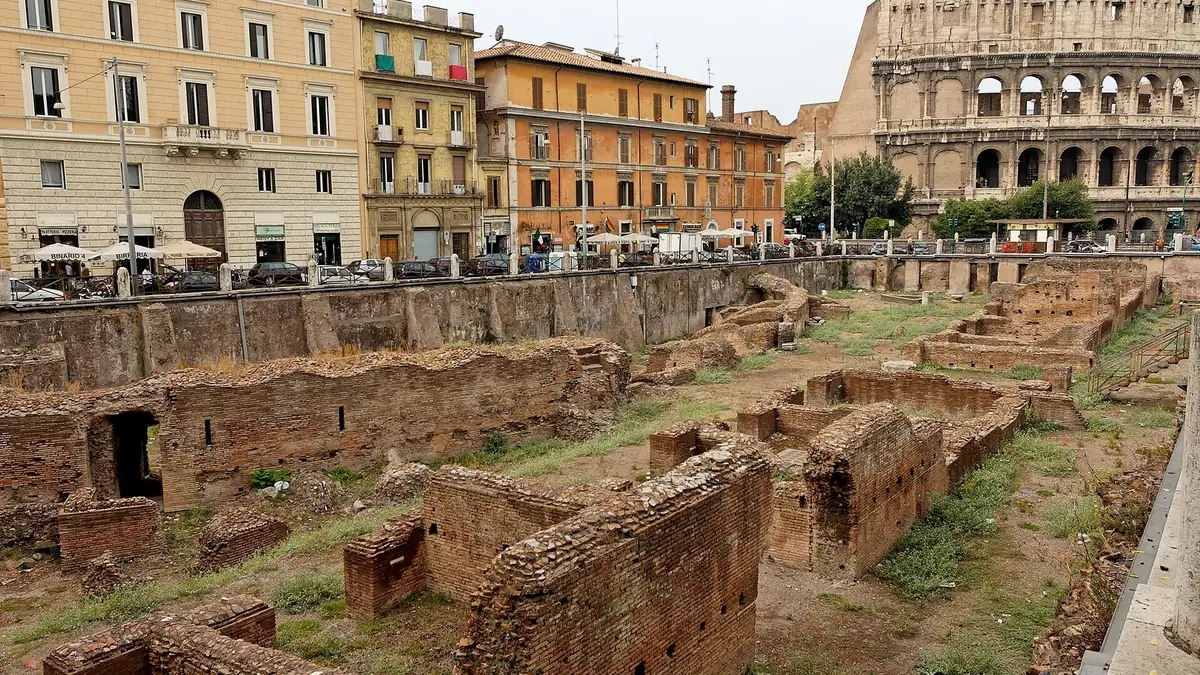
The ludus magnus was ancient Rome’s largest gladiator barracks, built by Domitian (81-96 AD) just east of the Colosseum. Little of it is on show now, and Turismo Roma announces a temporary closure for works, so check before you walk over.
Key figures: built 81-96 AD · found in 1937 · arena about 63 m x 42 m · about 3,000 spectators
“built by the emperor Domitian (81-96 AD)” Turismo Roma
What is the Ludus Magnus?
It was the largest gladiator school in Rome, the “Great Gladiatorial Training School”, where gladiators lived, ate and trained before fighting at the Colosseum. Domitian built it in the late first century AD.
Its other name was Domus Vectiliana. Three sister schools went up around the same time, the Dacian, the Gallic and the Matutinus (Morning School), and this one beat them all on size. A school in Latin is a ludus, same word as the games themselves.
How did gladiators train at the Ludus Magnus?
Newcomers were sorted by fighting specialty, given a doctore as trainer and placed under a lanista. They practiced in a small oval arena inside the barracks, watched by roughly 3,000 spectators.
The arena measured about 63 m by 42 m, a bit smaller than the Colosseum’s. Around the courtyard ran cells, and Turismo Roma says 14 on the north side survive. Nearby sat the Saniarum for the injured, the Spoliarium for stripping the dead, the Armamentaria for gear. What they ate has its own page.
Is there a tunnel from the Ludus Magnus to the Colosseum?
Yes, according to Turismo Roma, a gallery links the barracks to the Colosseum’s basement. Wikipedia adds that the digs on it are still inconclusive.
So don’t expect to walk it. The route reached the school at its southwestern corner, and a parallel path above ground is speculation. I’d call the tunnel real and its details unproven, and honestly that’s fine. For what happened upstairs, try a day at the games.
What can you see of the Ludus Magnus today?
Less than half the complex has been dug, the rest sits under street level and other buildings. The remains are mostly Trajan’s rebuild, which raised the plan by about 1.5 meters.
Courtyard, cells, and the curve of the cavea, plus one restored triangular fountain. Marble once covered much of the brick. Gone now.
| Date | What happened | Source |
|---|---|---|
| 81-96 AD | Domitian builds the school | Turismo Roma |
| 98-117 | Trajan rebuilds it, plan raised about 1.5 m | Turismo Roma |
| Late 2nd century | Fire damage, then work under Hadrian and Caracalla | Wikipedia |
| 1937 | Found during building work near the Colosseum | Wikipedia |
| 1957-61 | Excavation | Wikipedia |
| 1 Aug 2024 | Temporary closure announced for PNRR works | Turismo Roma |
Can you visit the Ludus Magnus now?
Probably not. Turismo Roma says individual visits needed a booking through 060608, then announces a temporary closure from 1 August 2024 with no reopening date.
Say you’re in Rome for a weekend and spotted the site on a map. The page you’d find says book by phone, then says closed. You’d ring 06 06 08 first, not trudge there. Old forum posts calling it “free and open” are out of date. I’d trust the city page and ask.
Map, starting points: Ludus Magnus, Via Labicana · Colosseo metro (Line B) · Via di San Giovanni in Laterano
Can you see the Ludus Magnus on a Colosseum night walk?
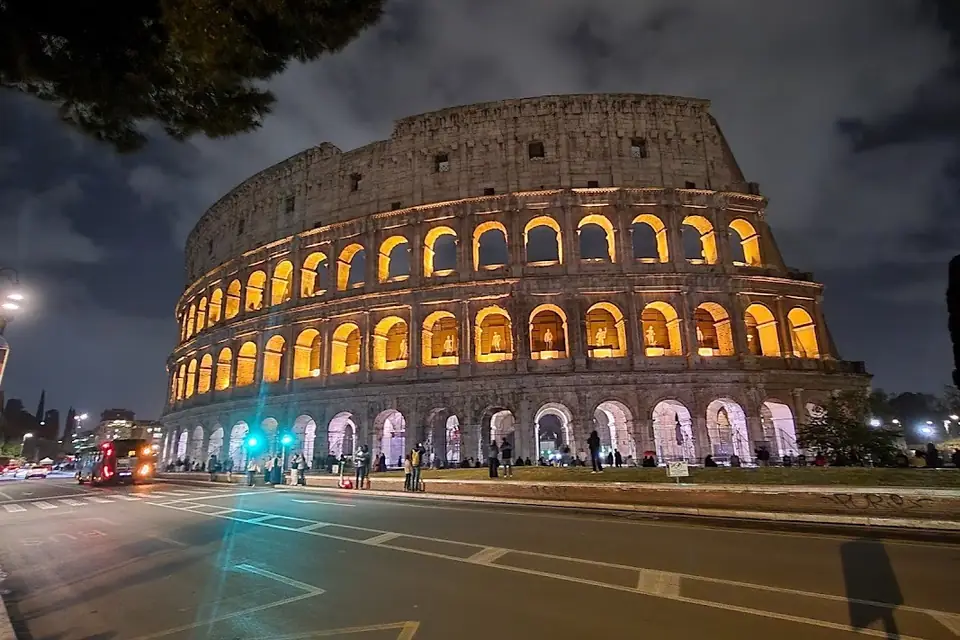
Not on the Park’s own tour: its route covers the first tier, arena and underground, and the Ludus isn’t named (our reading). A guided evening walk around the outside is the better bet.
Ask the guide before you book, since I can’t promise any operator stops on Via Labicana. The streets themselves are free. Our Colosseum night walking tour page explains what those walks cover.
Frequently asked questions
What does Ludus Magnus mean?
It’s Latin for “Great Gladiatorial Training School”, the name Wikipedia gives it. The word Ludus meant both a school and the games themselves.
When was the Ludus Magnus discovered?
Building work near the Colosseum uncovered it in 1937. Excavation came later, in 1957-61, per Wikipedia.
Why was the Ludus Magnus rebuilt?
Trajan raised the plan about 1.5 meters, and the school took fire damage in the late second century. Hadrian and Caracalla then repaired and altered it.
Were there other gladiator schools in Rome?
Yes, Domitian also built the Dacian, Gallic and Matutinus schools nearby. The Ludus Magnus was the largest.
More gladiators: Gladiators and the Games · what gladiators ate · a day at the games · Colosseum night tours