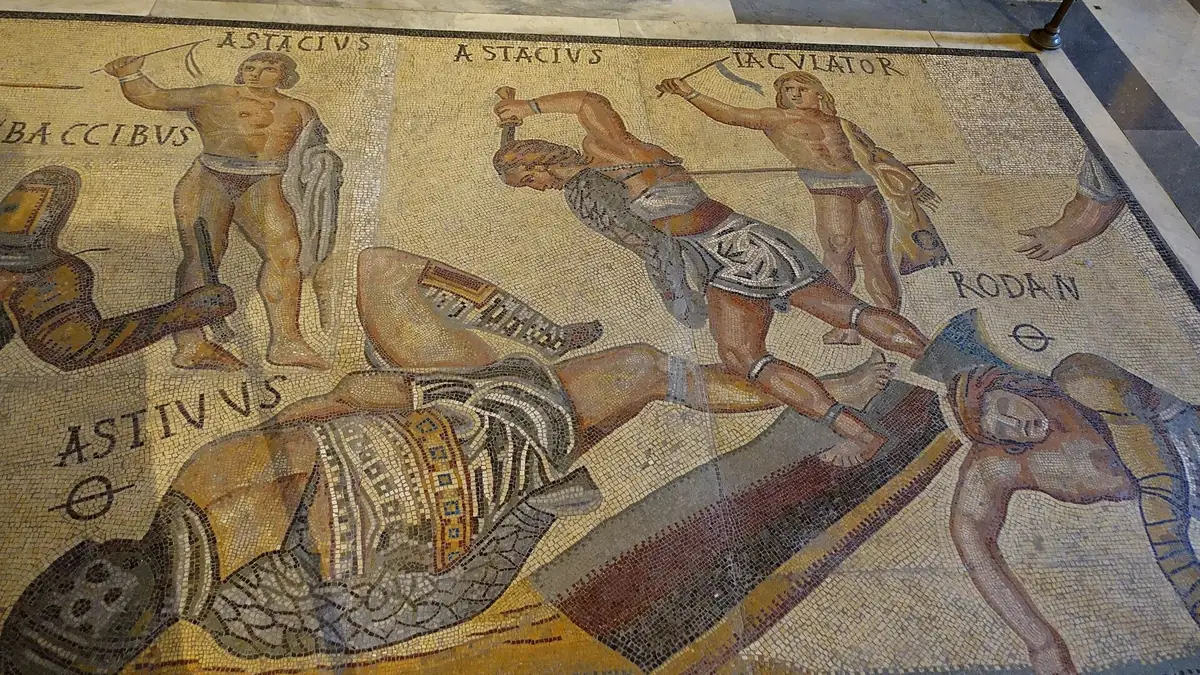
The famous gladiators people still name are Spartacus, Priscus and Verus, Carpophorus and the emperor Commodus, and only some of them ever stood in the Colosseum. I’ll sort the legend from the record, because most lists don’t.
Key dates: Spartacus revolts, 73 BC · Colosseum’s top level finished by Titus, AD 80 · Commodus’s last games, November AD 192 · Underground and Arena visit, 90 minutes
Who were the most famous gladiators?
Spartacus, Priscus and Verus, Carpophorus and Commodus are the names with the strongest ancient trail. Only the last three are tied to the Colosseum or its era.
| Name | Known as | When | Colosseum link |
|---|---|---|---|
| Spartacus | Thracian gladiator who led a revolt | Began 73 BC | None, he died before it was built |
| Priscus and Verus | Evenly matched pair praised by Martial | Inaugural games, AD 80 or 81 | Titus gave each a rudis, per Martial |
| Carpophorus | Bestiarius, an animal fighter | Inaugural games | Praised by Martial |
| Commodus | Emperor who fought as a gladiator | Reign from age 16; last games Nov 192 | Fought in the arena; venue not named in our sources |
Sources for the table: Spartacus, Gladiator, inaugural games, Commodus.
Honestly, nobody can crown a “deadliest” one. Ancient writers give us a handful of names and that’s it, so I’d distrust any page claiming a kill count. For the fighters’ classes, see types of gladiators; for the whole subject, the gladiators and the games hub.
Did Spartacus fight in the Colosseum?
No, he lived over a century and a half too early (our calculation). He escaped a gladiator school near Capua in 73 BC with about 70 others, and Titus finished the Colosseum’s top level in AD 80.
He was a Thracian who had served as a soldier with the Romans before enslavement, and Crassus was handed the job of crushing him. His fame comes from the war, not the sand. Whether he was a “slave who became a gladiator” is its own story: were gladiators slaves.
What happened between Priscus and Verus?
They fought so evenly, for so long, that both admitted defeat at the same instant. Martial describes how Titus then awarded victory and a rudis to each.
The rudis was the wooden sword that meant freedom. It’s the cleanest proof that a gladiator’s story didn’t always end in a death, and the question of how often it did is covered in did gladiators fight to the death. Carpophorus shared those games, as the star of the animal hunts: Martial praises him against a bear, a leopard and a lion.
Did Emperor Commodus really fight as a gladiator?
Yes. He entered the arena dressed as a secutor, and most of his bouts were bloodless affairs fought with wooden swords, which he invariably won.
Romans thought it shameful. In November 192 he shot hundreds of animals each morning and fought each afternoon, and he was assassinated by the wrestler Narcissus that year. I’d call him the least typical gladiator on the list, and the one with a staged result.
Where can you see the gladiators’ world at the Colosseum today?
The Colosseum Museum on the second level has a bay on the gladiator’s profession. The underground and arena ticket gives you 90 minutes inside, so plan the museum stop first.
“The following bay presents the profession of the gladiator and the subjects of the venationes” — Parco archeologico del Colosseo, Colosseum Museum
Say you book the Full Experience Underground and Arena for a morning slot. Ninety minutes is short, so I’d head up to the museum bay first, graffiti, mosaics, reliefs, then drop to the hypogeum. Last access is 4.40 pm, don’t cut it fine.
The “Passage of Commodus” is a trap for the unwary. The Park calls it “so-called” and dates it to the turn of the 1st and 2nd centuries AD. The name is later habit, not proof he walked it.
For a guided version, an authorised reseller lists a Colosseum Arena Floor, Roman Forum and Palatine tour from $43 for 2.5 hours. What you stand on is in the Colosseum arena floor guide.
Frequently asked questions
Who was Carpophorus?
He was a bestiarius, a fighter of animals, at the inaugural games. Martial praises him for dispatching a bear, a leopard and a lion.
Could a gladiator win his freedom?
Yes. The greatest reward was freedom, symbolised by a wooden rudis, as Priscus and Verus received.
Was Spartacus Roman?
No. He was Thracian, possibly of the Maedi tribe, and had served with the Romans before enslavement.
How did Commodus die?
A wrestler named Narcissus assassinated him in 192. Pertinax succeeded him, starting the Year of the Five Emperors.
More gladiators: all gladiators and the games · types of gladiators · did gladiators fight to the death · were gladiators slaves · Colosseum arena floor