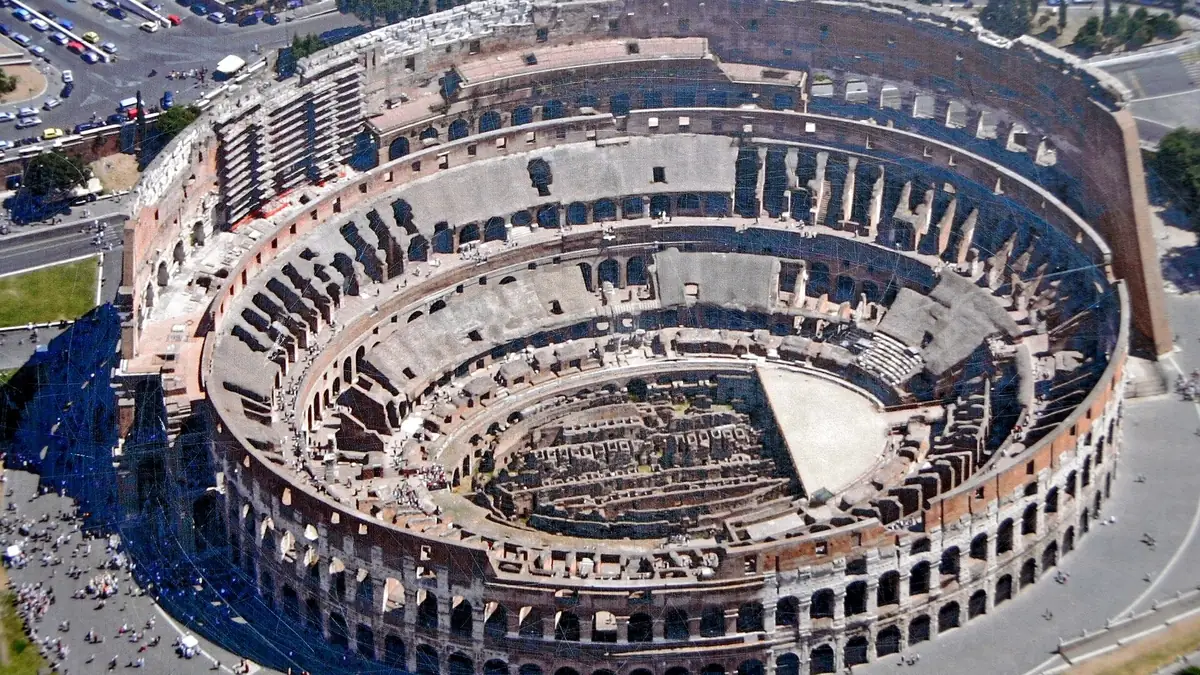
How much of the Colosseum is original has no official number. The Park publishes no percentage, and the “one-third” and “two-thirds” you see online come without a method. What I can do is show you which parts are ancient, which are lost, and which were propped up later.
Key figures: 189 m long · 156 m wide · 48 m high outer wall · 100,000+ m³ of travertine · 300 tons of iron clamps
“It is the largest amphitheatre in the world” Parco archeologico del Colosseo, The Colosseum
How much of the Colosseum is original?
Most of what you see is ancient masonry, but only part of the building. The ring is incomplete, the marble and seating are gone, and some supports are modern.
Pages quoting a percentage are guessing. Google’s own summary shrugs and says estimates run from 20% to two-thirds. I’d ignore every one and judge by section instead.
What part of the Colosseum is still standing?
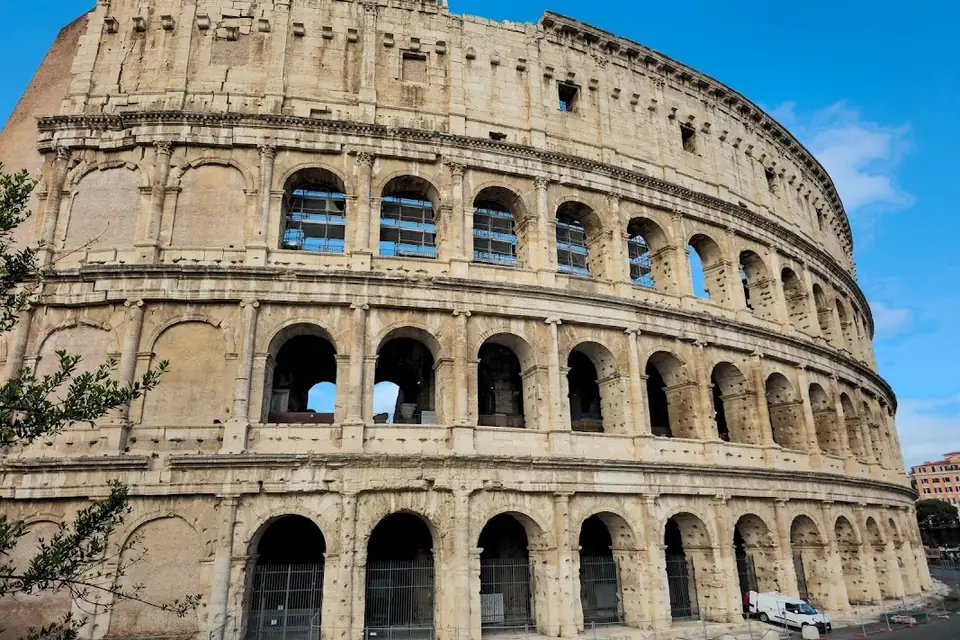
The north side of the outer wall still stands to its full height. Everything on the south side that looks like the outside is really the old inside wall, exposed when the outer ring fell.
The hypogeum, the underground network, is also clearly visible, though Domitian added it after the first opening. For the full layout, see inside the Colosseum.
What was lost, and why?
Earthquakes, fire and stone robbers. After the 1349 earthquake the outer south side, on softer ground, collapsed, and the tumbled stone went into other Roman buildings.
Then came the long looting. In the Middle Ages and Renaissance the building served as a quarry, partly for St. Peter’s Basilica. Marble facing was burned for quicklime and the iron clamps were pried out, leaving the pockmarks you can still see. That’s why the original look is so hard to picture, and why the materials story matters.
What has been restored or added?
Mostly stabilization, not rebuilding. Popes shored up the walls in the 19th century, and a big cleaning programme ran from 1993 to 2000.
| Date | Event |
|---|---|
| 217 | Fire destroys the wooden upper levels |
| 1349 | Earthquake brings down the outer south side |
| 1807 and 1827 | Triangular brick wedges added to the façade |
| 1810-1814, 1874 | Arena substructure partly excavated |
| 1930s | Substructure fully exposed; interior repaired |
| 1993-2000 | Major restoration programme |
Dates from the Wikipedia Colosseum article, the last-resort source here, because the Park’s page gives no dated list.
Is the arena floor original?
No. Little remains of the original arena floor, a wooden deck under sand, and what you stand on today is a modern surface over the exposed hypogeum.
I’d still do it, honestly. The Park’s arena-floor visit lasts 20 minutes, short, but you see the tiers from where the crowd’s roar pointed. More in the arena explained.
How can you tell old from new when you visit?
Look for the brick: the big triangular wedges at the north wall’s ends are early 19th-century additions. Pale travertine pocked with holes is the real thing, the holes being where clamps were hacked out.
Say you reach the north side at 9:20 with two kids who want “the real bit”. Point them at the tall curved wall, then at the brick wedge, and ask which one looks newer. They’ll get it in seconds. A guided tour does this better than I can in print, to be fair.
Map, starting points: Colosseo metro (Line B) · Piazza del Colosseo
Frequently asked questions
Does the Roman Colosseum still exist?
Yes, as a partial ruin in Rome’s archaeological heart. You can walk through it daily.
Why is only half the Colosseum left?
Earthquakes brought down the south side and centuries of stone robbing did the rest. Nobody rebuilt it, so the gap stayed.
Is any part of the Colosseum original?
Plenty, including the north wall, much of the inner structure and the underground walls. The brick wedges and arena surface are not.
Where do I read more on the building?
Start at the Colosseum architecture hub. It covers size, materials, construction and the levels.
More Colosseum architecture: Colosseum hypogeum · what the Colosseum looked like · all architecture