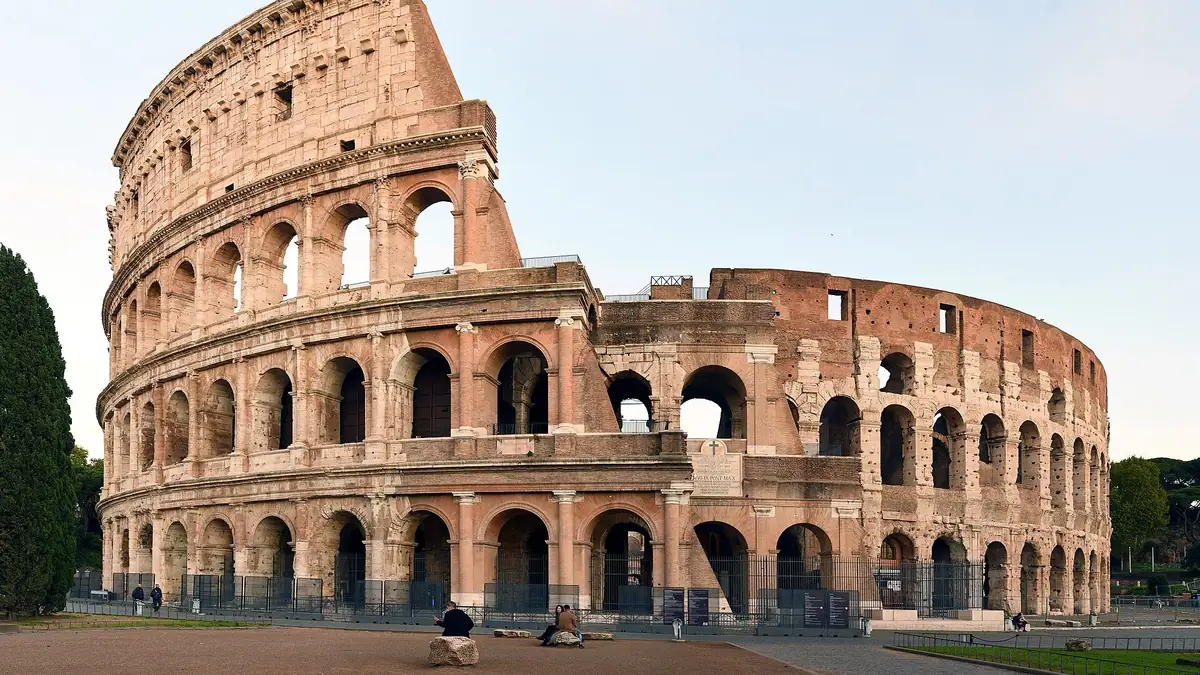
The Colosseum is made of three main materials: travertine, Roman concrete and tuff. Brick turns up too, mostly as a repair. Travertine, a pale limestone, is the star, the stuff you see on the outside.
At a glance: over 100,000 m³ of travertine · 300 tons of iron clamps · brick wedges added in 1807 and 1827 · 90 minutes inside
“It is the largest amphitheatre in the world.” Parco archeologico del Colosseo, The Colosseum
What materials was the Colosseum built from?
Travertine, Roman concrete and tuff, a volcanic rock. The concrete went into the foundations, corridor vaults and secondary brick walls.
I think people picture a big stone box, and that’s only the skin. Underneath it’s concrete, in the vaults and the hidden brick walls. Wikipedia’s travertine entry calls it the largest building in the world constructed mostly of travertine.
| Material | Where it was used | Fact |
|---|---|---|
| Travertine | Outer wall | Over 100,000 m³, set without mortar |
| Iron clamps | Joining the stone blocks | About 300 tons |
| Roman concrete | Foundations, corridor vaults, secondary brick walls | Listed with travertine and tuff as the main materials |
| Tuff | Volcanic rock, one of the three main materials | Listed in the same sentence |
| Brick wedges | Ends of the north wall | Modern, added 1807 and 1827 |
| Marble | Façade | Burned for quicklime in later centuries |
How much travertine is in the Colosseum?
The outer wall needed an estimated over 100,000 cubic metres of travertine. No mortar between the blocks.
Careful here: cubic metres is volume, and the 300 tons is the weight of the iron, not the stone. Some posters swap them. I’d ignore any page that says “100,000 tons of travertine” without a source.
Why does the Colosseum have holes in its walls?
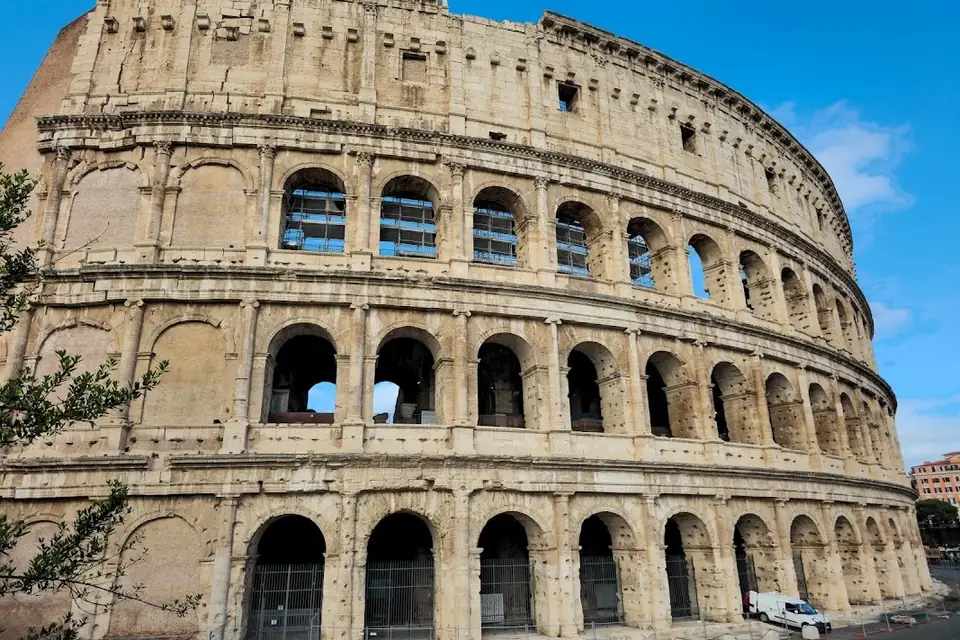
The holes are where iron clamps once held the stonework together. After the Colosseum went out of use, the clamps were pried or hacked out, leaving the pockmarks you see.
It was a quarry, basically. The Park itself notes that in the Middle Ages and Renaissance it became a quarry for building materials, part of it used for St. Peter’s Basilica. Stone, iron, marble… all fair game.
What was the Colosseum’s marble used for?
Marble covered the façade, but in later centuries it was burned to make quicklime. So the gleaming outside is gone.
What you see now is the structure underneath. A sad trade, if you ask me.
Is what we see today the original material?
Mostly, yes, with big gaps. The standing north side of the outer wall is original, but the triangular brick wedges at its ends are early 19th-century additions.
Odd detail: the rest of today’s exterior is the original interior wall, after the outer south side collapsed in the 1349 earthquake. For the longer version, see how much of the Colosseum is original.
What can you see and touch of the materials today?
Look at the pitted travertine from outside, and the brick wedges at the ends of the north wall. Inside time is 90 minutes on a Full Experience ticket.
Say you reach the gate at 9:20 with two kids who ask why the wall looks like Swiss cheese. You point at a hole, say “iron clamp, stolen”, and you’ve got the whole story in four words. For how it went up, read how the Colosseum was built, or go with a guide: colosseum guided tour options explain this on the spot.
Map, starting points: Colosseo metro (Line B) · Colosseo-Fori Imperiali (Line C) · Piazza del Colosseo — transport details from the Park
Frequently asked questions
Is the Colosseum made of marble?
No, the structure is travertine, concrete and tuff. Marble was on the façade and was later burned for quicklime.
Is the Colosseum made of concrete?
Partly, since Roman concrete was used for foundations, corridor vaults and secondary brick walls. The visible outer wall is travertine.
Were the travertine blocks glued with mortar?
No, they were set without mortar. Iron clamps, about 300 tons of them, held them together.
Are the brick wedges original?
No, they were added in 1807 and 1827 to reinforce the wall. You can spot them at both ends of the north side.
More architecture: Colosseum architecture hub · how it was built · how much is original · guided tour options · home