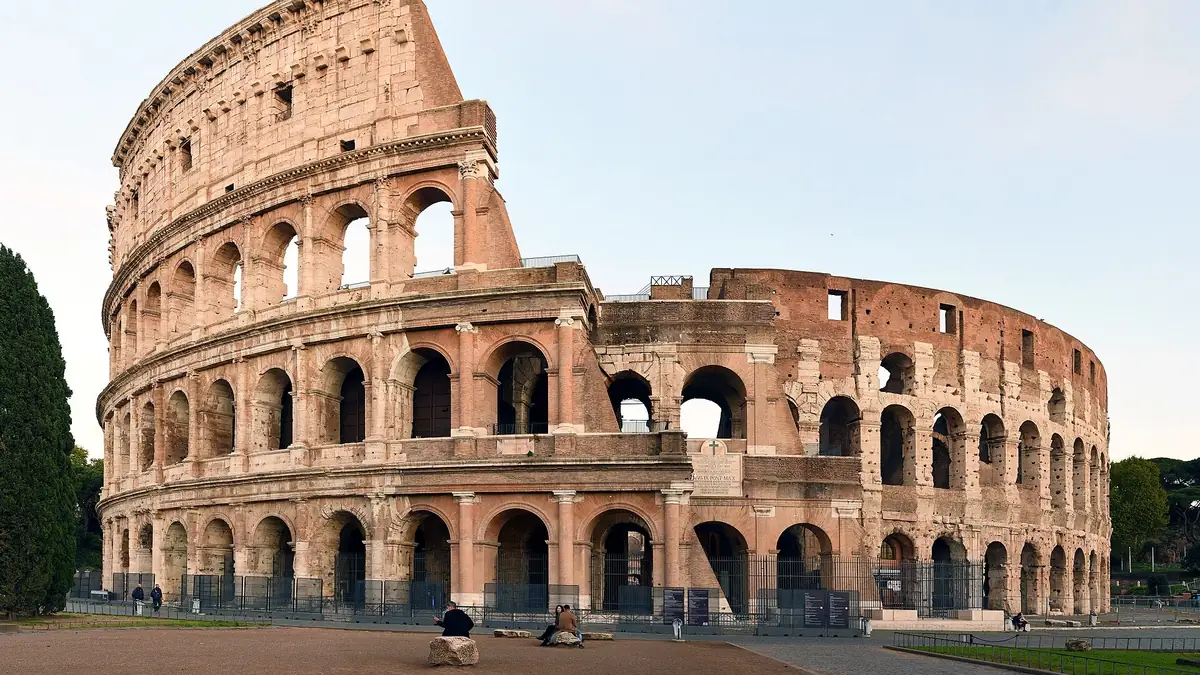
How was the Colosseum built? Fast, on a drained lake, and in stages. Work began around 70 to 72 AD under Vespasian, the top level was finished by his son Titus in 80, and later emperors kept tinkering.
Key figures: 189 m long · 156 m wide · 48 m high · 80 ground-level entrances
“the largest amphitheatre in the world, capable of presenting surprisingly complex stage machinery” Parco archeologico del Colosseo
Where was the Colosseum built?
On the flat floor of a low valley between the Caelian, Esquiline and Palatine hills, where Nero’s artificial lake had been. Vespasian had it filled in and reused for the new amphitheatre.
The Park confirms the lake: Nero’s palace had an artificial lake in the valley where the Colosseum stands today. Giving that ground back to the public was a canny political move, I think. Wikipedia calls it populist, and I agree.
How long did it take to build the Colosseum?
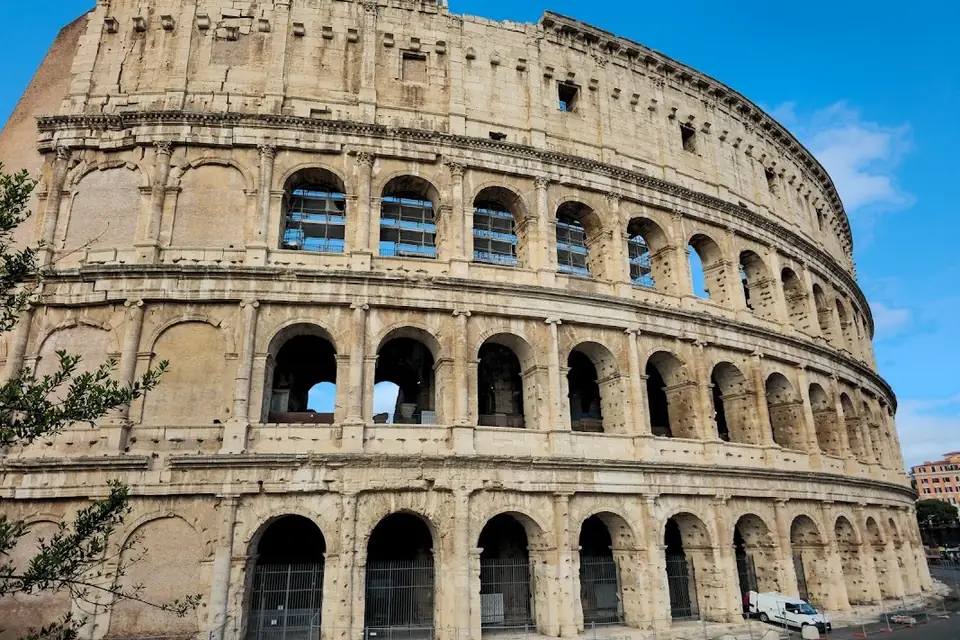
Roughly eight to ten years from first stones to opening, depending on which start date you trust. The official Park page only says it was built in the 1st century CE, so the finer dates come from Wikipedia.
| Phase | When | What happened |
|---|---|---|
| Site cleared | After the fire of 64 AD | Nero’s lake filled in |
| Start | c. 70-72 AD (some sources 73-75) | Vespasian begins |
| Third storey | By 79 AD | Complete at Vespasian’s death |
| Top level, opening | 80 AD | Titus finishes it; inaugural games 80 or 81 |
| Underground, extra gallery | After 81 AD | Domitian |
Dates from Wikipedia’s Colosseum article. Nobody agrees on one start year, which is why “8 years” is a soft number.
How did the Romans make a freestanding stadium stand up?
By building it like two theatres back to back, in an oval, with no hillside to lean on. It was entirely freestanding, unlike Roman theatres cut into slopes.
Concrete went into the foundations, corridor vaults and secondary brick walls. Eighty ground-level entrances, each numbered, kept crowds moving, the same trick modern stadiums use. Tiers of arches stacked three high, topped by a solid attic.
What was the Colosseum built from?
Travertine for the outer wall, tuff and brick for lesser walls, concrete for the vaults. The outer wall needed over 100,000 cubic metres of travertine, set without mortar and held by 300 tons of iron clamps.
That’s the claim, anyway; it’s an estimate. For the full material breakdown, see what the Colosseum is made of.
Who built the Colosseum?
Professional Roman builders, engineers and artists did the skilled work. Slaves and prisoners of war are often assumed to have supplied unskilled labor, though that part is assumption.
The money is better documented: a reconstructed inscription says Vespasian ordered it built from his general’s share of the booty after the Jewish war. No cost figure survives in anything I could open, so I won’t invent one.
When was the underground added?
After the opening, under Domitian. The hypogeum was not part of the original construction: a two-level network of tunnels and cages under a wooden, sand-covered floor.
Say you stand on the arena floor with a ticket that includes the underground, 90 minutes on the clock. Everything beneath your feet was a later fix to an already working building, which changes how you read it. The Park lists the underground as subject to availability, bookable 30 days ahead. How it worked is in the hypogeum guide, and the Colosseum underground tour page covers access.
Map, starting points: Piazza del Colosseo · Colosseo metro (Line B) · Domus Aurea, Oppian Hill
Frequently asked questions
Was the Colosseum ever finished?
Mostly in 80 AD, but not entirely. Domitian then added the underground and a top gallery for more seats.
How much did the Colosseum cost to build?
No figure appears in the sources I opened. The funding is documented, though: spoils from the First Jewish-Roman War.
Why is it called the Colosseum?
The name comes from a colossal statue that stood nearby, according to the Park’s own account. Its proper name is the Flavian Amphitheatre.
Did it have a roof?
Not a solid one. Sailors worked a retractable canvas awning held on 240 mast corbels, covered in the velarium guide.
More architecture: Colosseum architecture · every level explained · Colosseum night tour