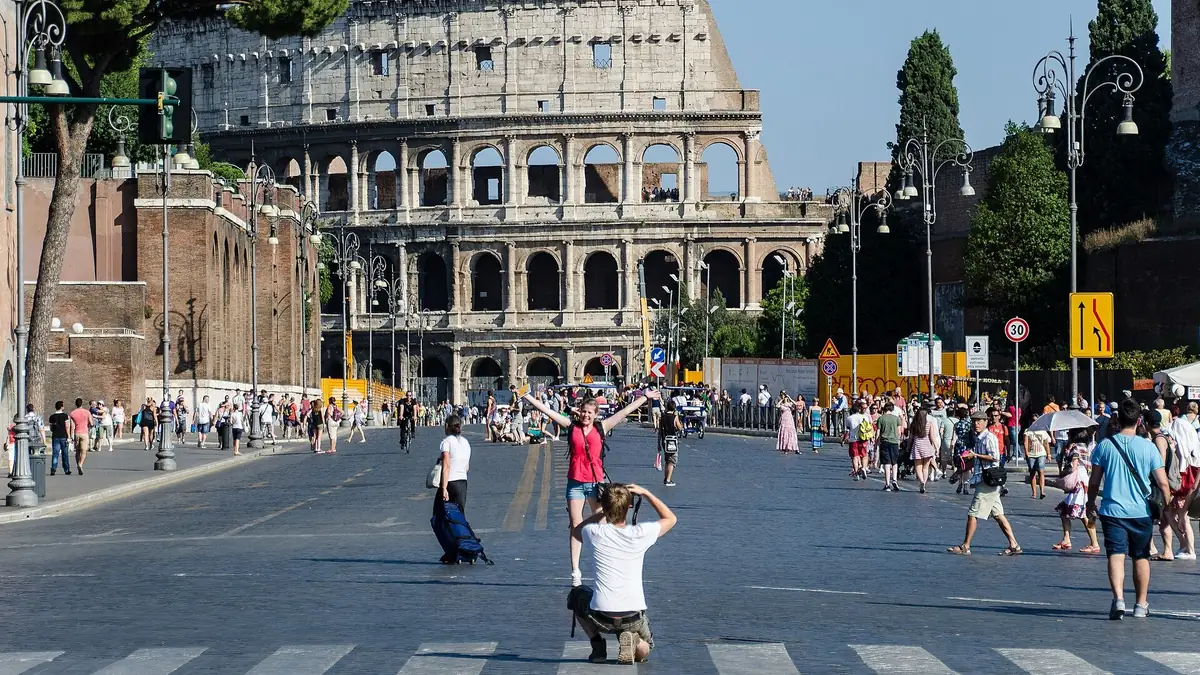
What did the Colosseum look like when it was new? A free-standing oval of travertine arches, three storeys plus a tall top wall, with statues in the upper arches, tiered seating inside and a rope-and-canvas awning above. Much of that is gone. Some of it you can still point at.
Key figures: 189 m long · 156 m wide · 48 m outer wall · 80 entrances · 240 awning corbels
“It is the largest amphitheatre in the world.” Parco archeologico del Colosseo
What did the Colosseum look like from the outside?
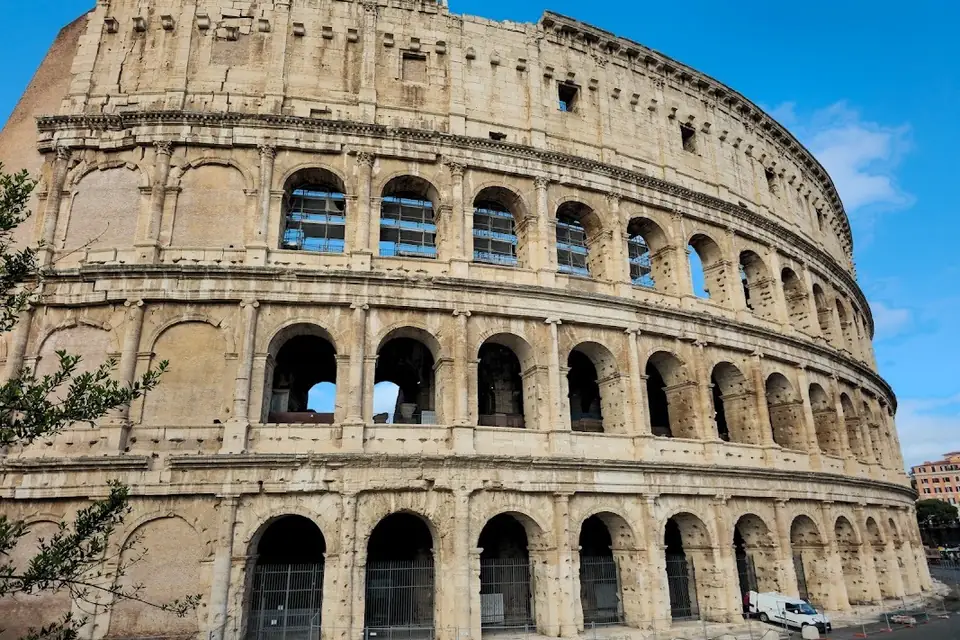
It was an oval wall of arcades, three storeys topped by a tall attic wall, about 48 meters high. Columns framing the arches ran Doric, Ionic, then Corinthian going up, and the attic carried Corinthian pilasters.
It stood alone, not cut into a hillside like a Roman theatre. The travertine, concrete and tuff it was built from still show, though the south side fell in the 1349 earthquake. So the ring you see today is partly a broken one… the original was closed all the way round.
Did the Colosseum have statues?
Yes, in the arches: each arch of the second- and third-floor arcades framed a statue, probably gods and figures from mythology. The museum shows an extraordinary repertoire of marbles from the decoration.
The name itself comes from a statue. The Park says the building became known as the Colosseum because of a colossal statue that stood nearby, and Wikipedia identifies it as a bronze Nero, moved beside the amphitheatre under Hadrian.
What did the inside of the Colosseum look like?
A steep bowl of seating, sorted by rank. The emperor and the Vestal Virgins had special boxes at the north and south ends, senators sat on a podium beside them, and ordinary citizens sat higher up on stone and, later, marble seating.
The very top gallery, added under Domitian, was standing room or steep wooden benches for the poor, slaves and women. Wood burned: a fire in 217 destroyed the wooden upper levels. The floor was timber too, covered with sand, over the underground tunnels.
Was the Colosseum painted?
Partly, and that’s about all I can prove. The four main entrances were richly decorated with painted stucco reliefs, and fragments survive.
I’d be wary of any render showing the whole building in bright colour or gleaming white marble. The sources I opened document painted stucco at the gates and marble ornament and seating, nothing more. The rest is educated guesswork, even when the 3D model looks good.
Did the Colosseum have a roof?
Not a solid one. It had a retractable awning, the velarium: a canvas-covered net of ropes, held up by 240 mast corbels around the top of the attic, with a hole in the centre.
Sailors from the fleet at Misenum worked it. The slope also created a ventilation updraft, a breeze in a stone bowl in a Roman summer. Lovely detail. The full story sits on the velarium page.
Where can I still see the original Colosseum?
Look down into the exposed tunnels and inside for the museum. The Museum of the Colosseum sits on the second level, with architectural fragments, the marbles, a diagram of the seating divisions and the scholarly Lucangeli model.
| Feature | Ancient design | What happened later |
|---|---|---|
| Size | 189 m by 156 m, outer wall 48 m | South outer side collapsed in the 1349 earthquake |
| Entrances | 80 at ground level, 76 for ordinary spectators | Many outer entrances lost with the collapse |
| Statues | In the arches of floors 2 and 3 | Marbles shown in the museum |
| Seating | Stone, later marble, by rank | Interior stripped of stone; decline after 438, later a quarry |
| Arena floor | Wooden, covered with sand | Little of it remains; the tunnels beneath are visible |
Say you reach the Colosseum at opening with a teenager who only knows the film version. Start in the museum, where the model tells you what to look for, then stand under the second-level arches and count the empty ones. The upper levels come with steep steps and a 90-minute stay, which is why I’d fit the colosseum attic in last, when legs still work.
Map, starting points: Piazza del Colosseo · Colosseo metro (Line B) · Colosseo-Fori Imperiali (Line C)
Frequently asked questions
How tall was the Colosseum originally?
The outer wall measured 48 meters. Its footprint was 189 by 156 meters.
Is the Colosseum the original building?
Yes, it’s the same structure, but reused as a quarry and shelter for centuries and shaken by an earthquake in 1349. How much survives is covered on how much of the Colosseum is original.
When did the Colosseum open?
Work reached the third storey by Vespasian’s death in 79 and Titus finished the top level in 80. The inaugural games were held in 80 or 81 AD.
Why is it called the Colosseum?
Because of a colossal statue that stood nearby. Its proper name is the Flavian Amphitheatre.
More architecture: Colosseum architecture · inside the Colosseum · what it’s made of · the velarium · Colosseum night tour