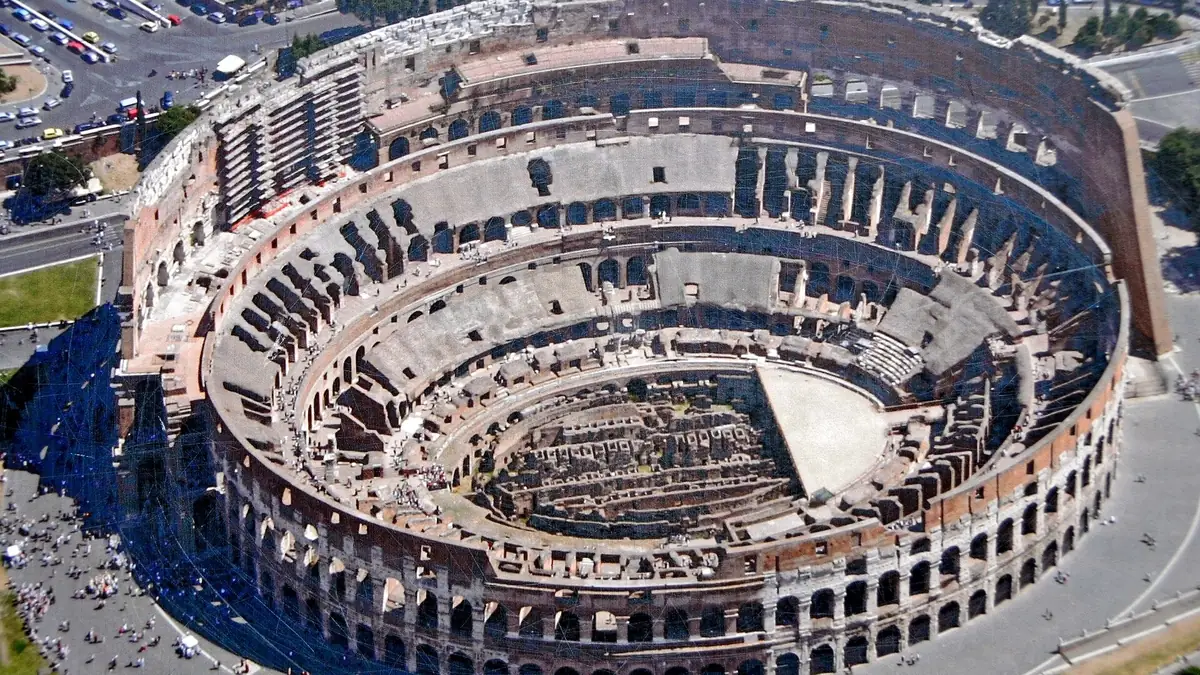
Asking why is the Colosseum broken gets you two culprits: the great earthquake of 1349, which dropped the outer south wall, and centuries of Romans who treated the ruin as a quarry for building materials. Age alone didn’t do this.
Key figures: 1349 earthquake · over 100,000 m³ of travertine · 300 tons of iron clamps · quarrying banned 1749
“In the Middle Ages and Renaissance it even became a quarry for building materials.” Parco archeologico del Colosseo
Why is the Colosseum broken?
Fire, earthquakes and then plunder, in that order. The 1349 quake brought down the south side, and the fallen stone was reused across Rome.
The damage didn’t come in one go. It ran for centuries, and honestly the dates are the clearest way to see it:
| Year | What happened | Effect |
|---|---|---|
| 217 | Major fire, lightning according to Dio Cassius | Wooden upper levels destroyed; not fully repaired until about 240 |
| 443 | Major earthquake (possibly) | Repairs recorded under Theodosius II and Valentinian III |
| 1349 | Great earthquake | Outer south side collapsed |
| 1377 | Restoration by a religious order | Part of the north side inhabited into the early 19th century |
| 1749 | Pope Benedict XIV | Forbade use of the Colosseum as a quarry |
| 1807 and 1827 | Triangular brick wedges added | Façade reinforced |
All rows from Wikipedia’s history of the Colosseum.
Why is one side of the Colosseum missing?
The south side stood on less stable alluvial ground, so the 1349 earthquake collapsed the outer wall there. The north side of the perimeter wall still stands.
That’s the whole asymmetry, and it’s the part the viral posts get right. The pointed brick wedges at each end of the surviving wall aren’t Roman: they’re early 19th century props, and I’d look at them first.
Who took the stone from the Colosseum?
Rome did. After the decline that followed the games’ abolition in 438, the building became a quarry, and part of it went into St. Peter’s Basilica.
The fallen stone built palaces, churches and hospitals, and the interior was stripped. The marble façade got burned for quicklime. The Pope’s move to Avignon had shrunk the city, and nobody was left to say no… a giant free hardware store.
What are the holes in the Colosseum’s stone?
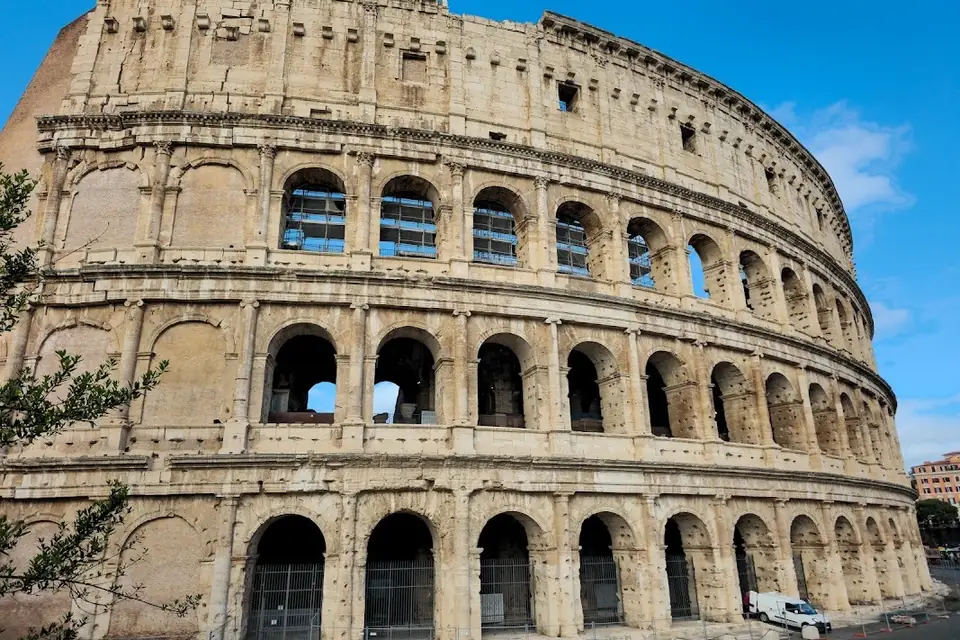
They’re where iron went. The outer wall used over 100,000 cubic metres of travertine set without mortar, held by 300 tons of iron clamps, and later builders pried the clamps out.
Each clamp hacked free left a pockmark, and they still scar the building today. Metal was worth more than old stone. Simple as that.
Map, starting points: Piazza del Colosseo · Colosseo metro (Line B) · Colosseo-Fori Imperiali (Line C)
Has the Colosseum been restored?
Stabilised, yes. Rebuilt, no: UNESCO notes that from the 19th century a careful policy of protection and restoration was applied, and the Colosseum was among the first places those principles were tested.
I think that explains the “why don’t they fix it” question. The wedges prop the wall up and the missing side stays missing, which is the point of the policy. Full detail is on the Colosseum restoration page.
What should you look for when you visit?
Compare the two sides, then read the pockmarks. Walk round the outside first, the intact north wall against the broken south, and only then go in.
Say you stand in Piazza del Colosseo with a teenager who asks where the other half went. Point at the tall wall, then the low broken edge, then at the holes in the stone. Inside, the Full Experience Underground and Arena ticket allows 90 minutes, goes on sale 30 days ahead, and gives underground access subject to availability. Tours are compared on the best Colosseum tour page.
Frequently asked questions
Did the Colosseum burn down?
No, but it burned badly. A major fire in 217 destroyed the wooden upper levels, and repairs weren’t finished until about 240.
Is the Colosseum still standing?
Yes, partly. The north side of the outer wall still stands, while the outer south side collapsed in the 1349 earthquake.
Why doesn’t Rome rebuild the missing wall?
Official policy since the 19th century has been protection and restoration rather than reconstruction, and the brick wedges only support what survives. That’s our reading of the UNESCO text and the wall itself.
When did people stop taking stone from the Colosseum?
In 1749 Pope Benedict XIV forbade its use as a quarry. He consecrated it to the Passion of Christ instead.
More history: Colosseum History & Facts · when the Colosseum was last used · Colosseum night tour guide