The best Colosseum facts are the ones you can check. It is the largest amphitheatre in the world, 189 meters long, begun by the Flavian emperors in the 1st century, and most of what looks broken was done by earthquakes and by centuries of stone-hunting, not by the Romans.
Key figures: 189 m long · 48 m high · about 50,000 spectators · 80 entrances
“It is the largest amphitheatre in the world” — Parco archeologico del Colosseo
How big is the Colosseum?
It is 189 meters long, 156 meters wide and 48 meters high at the outer wall. The base covers 24,000 square meters, and unlike most Roman theaters it is a free-standing oval, not dug into a hillside.
| Fact | Figure |
|---|---|
| Length | 189 m (615 ft) |
| Width | 156 m (510 ft) |
| Outer wall height | 48 m (157 ft) |
| Perimeter | 545 m (1,788 ft) |
| Base area | 24,000 m² |
| Travertine in the outer wall | over 100,000 m³, estimated |
| Iron clamps | 300 tons |
Figures from Wikipedia’s Colosseum article, which is the only opened source with dimensions; the Park’s own page gives none.
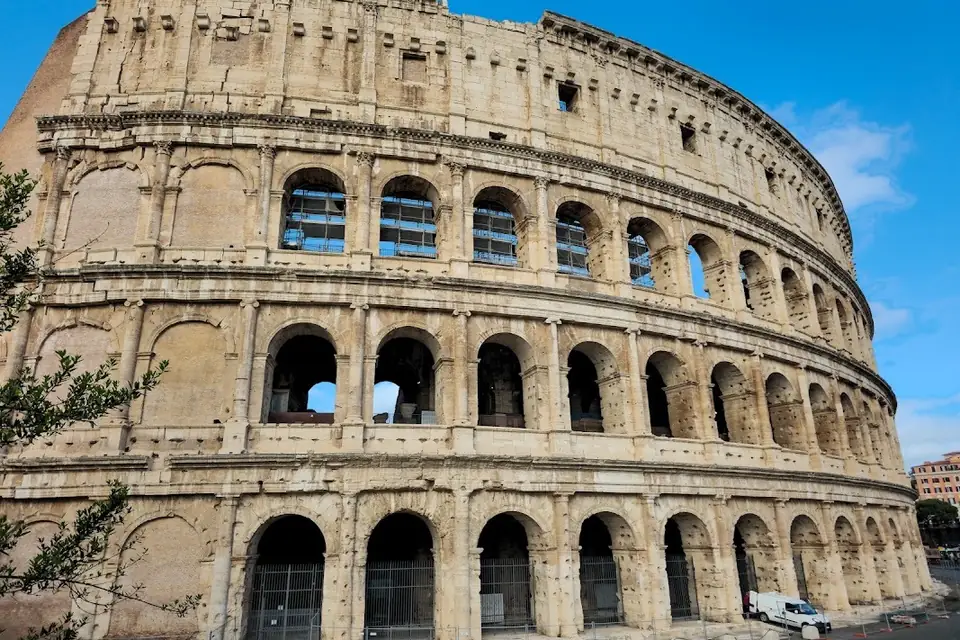
No mortar in that travertine, by the way. Iron clamps held it together. I find that more striking than any height.
How was the Colosseum built?
Vespasian started it around 70 to 72 AD on the filled-in lake of Nero’s palace grounds, and his son Titus finished the top level in 80. Domitian added the underground hypogeum and a gallery to raise capacity.
Money came from the booty taken after the siege of Jerusalem in 70 AD. Slave and prisoner labor is “often assumed” there, alongside professional builders and engineers, so I’d distrust any list that says exactly 60,000 slaves for ten years. Nobody has that number. When it opened, Dio Cassius says over 9,000 wild animals were killed in the inaugural games. Dates in more depth: when the Colosseum was built.
How many people could the Colosseum hold?
Modern estimates say around 50,000, though a 4th-century calendar claims 87,000. Eighty ground-level entrances, 76 for ordinary spectators, kept the crowd moving.
Each entrance and staircase was numbered, and spectators carried numbered pottery shards telling them their section and row. The top gallery, added by Domitian, was for the poor, slaves and women.
Say you reach the gate at 9:20 with two kids and a 9:30 slot. Glance up before you queue: entrances XXIII to LIIII still survive, numerals and all, and the Romans found their seat the same way you’re finding your gate. Kids like that one.
What happened inside the Colosseum?
It staged animal hunts (venationes) and gladiator fights (munera) on a wooden floor covered in sand, which is where arena comes from. Underneath, a two-level hypogeum of tunnels and cages fed the show through eighty vertical shafts.
Shade came from the velarium, a retractable awning on 240 mast corbels, worked by sailors from the fleet at Misenum. Covered two-thirds of the arena.
Flooded sea battles? Ancient accounts say the arena could be flooded, but the source notes there is no physical evidence of naval battles at the Colosseum, and the hypogeum ended flooding early on. I’d call it unproven, not false.
What happened to the Colosseum after the games ended?
The Park dates the slow decline to 438, when Valentinian III abolished the gladiatorial games. It then became a quarry, with some stone going into St. Peter’s Basilica, and later held workshops, homes and animals.
A fire in 217 destroyed the wooden upper levels, and earthquakes brought down the outer ring. Only the north side of that ring stands. The triangular brick wedges at either end are early 19th-century props, and the rest of today’s “outside” is the old inner wall. Full story: why the Colosseum is broken.
Which Colosseum facts can you see on a night visit?
The Park’s own evening visit, A Night at the Colosseum, is about 60 minutes for 25 people through the first tier, the arena and the underground. It costs €50.00 at full price, and the 2026 season ran Tuesdays and Thursdays from 7 July to 29 September.
You get the hypogeum and the Fosso Labicano corridors, not just the arches. Honestly it’s the best way to make the numbers above feel physical. Sorting official from guided evenings: which Colosseum night tour should I book.
Map, starting points: Colosseo metro (Line B) · Colosseo-Fori Imperiali (Line C) · Piazza del Colosseo
Frequently asked questions
Why is it called the Colosseum?
The Park says it took the name from a colossal statue that stood nearby, generally taken to be the bronze Colossus of Nero at the entrance to the Domus Aurea. Its formal name is the Flavian Amphitheatre; more in why it is called the Colosseum.
Was the Colosseum built by slaves?
Partly, it’s often assumed that slaves and prisoners of war supplied the unskilled labor. Teams of professional builders, engineers and artists did the specialized work, and no source gives a head count.
Is the Colosseum a UNESCO World Heritage Site?
Yes, as part of the Historic Centre of Rome property, where UNESCO names it among the monuments of antiquity. It is not listed as a separate site.
Did they fill the Colosseum with water?
Ancient accounts say the arena could be flooded rapidly, probably from a nearby aqueduct. The hypogeum ended that early, and there is no physical evidence of naval battles there.
More Colosseum history: Colosseum History & Facts · when it was built · why it is called the Colosseum · why it is broken · Colosseum night tour guide